

What Does Chevrolet Super Cruise Actually Do?
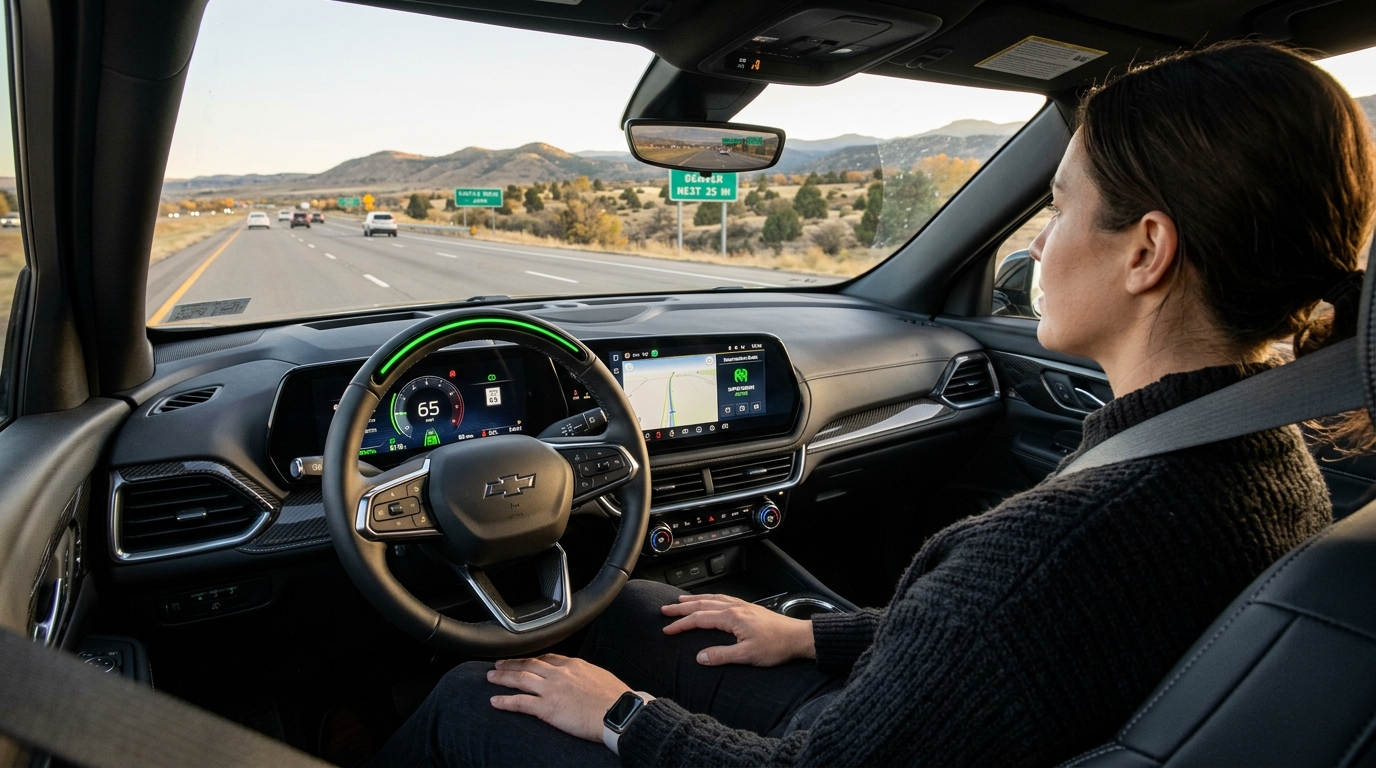
Chevrolet Super Cruise is an advanced hands-free driver assistance technology that manages steering, braking, and acceleration across more than 600,000 miles of compatible pre-mapped highways in North America. Utilizing high-precision LiDAR map data, real-time camera networks, long-range radar sensors, and GPS positioning, the system maintains lane position and speed while an infrared driver attention system ensures the driver remains engaged with the road.
Unlike basic cruise systems, Super Cruise allows complete hands-free steering on compatible divided highways when operating conditions are met. The system monitors lane markings, surrounding traffic speed, and distance to leading vehicles via Adaptive Cruise Control, helping adjust speed down to a stop in heavy traffic and resume when movement restarts.
For drivers commuting from Golden into the metro area along major highway corridors, this technology transforms long stretches of driving by reducing physical fatigue. The system works seamlessly through intuitive steering wheel light bar indicators:
- Solid Green Light: Super Cruise is active and actively steering the vehicle hands-free.
- Flashing Green Light: The system requires the driver to pay immediate attention and hold the wheel.
- Flashing Red Light: Super Cruise is disengaging immediately, requiring manual steering take-over.
To explore how these advanced hands-free technologies work across our lineup, visit our Englewood showroom location or give our sales team a quick call at (303) 761-0333 to set up a demonstration.
Table of Contents
- What Features Stop Working If Your Super Cruise Subscription Expires?
- Which Chevrolet Vehicles Offer Super Cruise Technology and Automatic Lane Changing?
- How Does the Driver Attention System Maintain Safety and Handle Unresponsive Drivers?
- How Does Super Cruise Compare to Ford BlueCruise and Tesla FSD on Highway Miles and City Streets?
- Common Questions About Operating Chevrolet Super Cruise Technology
- Experience Hands-Free Chevrolet Innovation at John Elway Chevrolet
What Features Stop Working If Your Super Cruise Subscription Expires?
If your Super Cruise plan or initial trial expires, the hands-free steering functions, Automatic Lane Change, and trailering assistance features will deactivate. Standard Adaptive Cruise Control, lane departure warning, and conventional crash avoidance systems remain fully operational, allowing you to maintain set speeds and safe following distances using manual steering input.
Every new Chevrolet model equipped with hands-free driving capabilities includes an initial trial period—typically three years of connected services on newer models—to support map updates, real-time GPS tracking, and cellular data connections. Continuous high-definition LiDAR map connectivity is required to verify road conditions and active construction zones. Without an active connectivity plan:
- Hands-free steering activation is unavailable on mapped highways.
- Automatic Lane Change and signal-activated passing features turn off.
- Integrated route planning for hands-free roads within Google Maps disables.
- Built-in trailering gap adjustments tied to hands-free operation revert to manual settings.
Maintaining an active plan ensures your vehicle receives over-the-air software updates expanding highway map coverage and refining sensor performance. If you are considering purchasing a vehicle from our pre-owned vehicle inventory, our team can verify whether the vehicle’s hands-free trial is still active or assist you in setting up a subscription. You can also meet our dealership team online to connect with a technology specialist who can walk you through subscription management.
Which Chevrolet Vehicles Offer Super Cruise Technology and Automatic Lane Changing?
Chevrolet offers Super Cruise and Automatic Lane Change across a wide spectrum of SUVs and trucks, including the Chevrolet Tahoe, Chevrolet Suburban, Chevrolet Traverse, Chevrolet Silverado 1500, Chevrolet Silverado EV, Chevrolet Blazer EV, and Chevrolet Equinox EV. On select models like the Chevrolet Silverado 1500, the technology comes standard on luxury trims such as High Country and off-road models like the ZR2, while remaining available as an option across other trims.
When shoppers compare SUV configurations on our showroom floor, they frequently ask how hands-free technology handles heavy towing or family travel. The system adapts specifically to each platform’s capability:
- Chevrolet Tahoe: Paired with the 5.3L V8 engine and offering up to 6,600 lbs of towing capacity, the Chevrolet Tahoe provides ample cargo space for family gear alongside hands-free highway guidance for family road trips.
- Chevrolet Traverse: This 3-row family SUV features an 8-speed automatic transmission, a 2.5L engine, and 23 cubic feet of rear cargo space behind the third row, making it ideal for daily suburban routes and mountain drives.
- Chevrolet Silverado EV: Delivering all-wheel drive, up to 493 miles of EV range depending on battery configuration, and 11 cubic feet of front trunk space, this electric pickup integrates Super Cruise with specialized trailering capabilities.
On properly equipped vehicles, Automatic Lane Change evaluates surrounding traffic speed and gap intervals to pass slower vehicles without driver steering input. When pulling a boat or camper, the system automatically detects the trailer and increases the following distance behind leading vehicles to allow additional stopping space.
You can browse our new Chevrolet inventory to see which models currently feature hands-free equipment, or schedule a service appointment to have our certified technicians perform routine software updates on your current vehicle.
Engine & Performance
Powertrain specs by trim
| Feature | LT Extended Range | LT Max Range | LT Standard Range | RST Extended Range |
|---|---|---|---|---|
| Horsepower | 645 hp | 760 hp | 510 hp | 645 hp |
| Torque | 765 lb-ft | 765 lb-ft | 580 lb-ft | 785 lb-ft |
| Transmission | automatic 1-speed | automatic 1-speed | automatic 1-speed | automatic 1-speed |
| Drivetrain | All-wheel drive | All-wheel drive | All-wheel drive | All-wheel drive |
Engine & Performance (continued)
| Feature | RST Max Range | Trail Boss Extended Range | Trail Boss Max Range | Work Truck Extended Range |
|---|---|---|---|---|
| Horsepower | 754 hp | 625 hp | 725 hp | 510 hp |
| Torque | 785 lb-ft | 775 lb-ft | 775 lb-ft | 580 lb-ft |
| Transmission | automatic 1-speed | automatic 1-speed | automatic 1-speed | automatic 1-speed |
| Drivetrain | All-wheel drive | All-wheel drive | All-wheel drive | All-wheel drive |
Engine & Performance (continued)
| Feature | Work Truck Max Range | Work Truck Standard Range |
|---|---|---|
| Horsepower | 510 hp | 510 hp |
| Torque | 580 lb-ft | 490 lb-ft |
| Transmission | automatic 1-speed | automatic 1-speed |
| Drivetrain | All-wheel drive | All-wheel drive |
How Does the Driver Attention System Maintain Safety and Handle Unresponsive Drivers?
The Super Cruise driver attention system maintains safety using a steering-column-mounted infrared camera that tracks driver head position and eye gaze, ensuring focus remains on the road ahead. Because the camera uses infrared light, it monitors driver attentiveness accurately through sunglasses, in low-light conditions, and during night driving.
If the driver looks away from the road or closes their eyes for more than a few seconds, the vehicle initiates a multi-stage alert sequence designed to prompt immediate re-engagement:
- First Alert: The steering wheel light bar flashes green to remind the driver to focus on the road.
- Second Alert: If attentiveness is not restored, the light bar flashes red, accompanied by audible chimes or haptic seat vibrations via Safety Alert Seat technology.
- Third Alert: If the driver fails to respond to flashing red lights and chimes, a voice prompt announces that Super Cruise is disengaging, requiring immediate manual control.
- Emergency Stop: Should the driver remain completely unresponsive—such as during a medical emergency—the vehicle slows down and comes to a stop in its current lane, activates hazard lights, and may initiate an OnStar emergency call for help.
For drivers commuting from quiet suburban estates in Cherry Hills Village onto busy highway corridors, this multi-layered monitoring provides complete peace of mind. To prepare for upgrading your current ride to a hands-free model, use our online trade-in valuation tool to receive an estimated market value for your trade-in vehicle.
How Does Super Cruise Compare to Ford BlueCruise and Tesla FSD on Highway Miles and City Streets?
Ford BlueCruise currently covers approximately 130,000 miles of mapped highways, less than Chevrolet Super Cruise’s 600,000 miles, which indicates a larger mapped network for Super Cruise. While Ford’s system operates on designated highway networks, Chevrolet’s extensive mapping includes major interstates, state highways, and divided trunk routes, allowing for longer uninterrupted hands-free driving segments.
Unlike Tesla Full Self-Driving (FSD), which attempts to navigate unmapped urban streets, stop signs, and city intersections using camera vision alone, Super Cruise is engineered specifically for mapped, divided highways. This dedicated design focus yields several key performance advantages:
- Hands-Free Trailering: Chevrolet offers true hands-free trailering capability on trucks like the Chevrolet Silverado EV, adjusting vehicle gap distance automatically when towing. Competitor systems do not offer hands-free towing support.
- Direct Eye Tracking: Chevrolet uses direct infrared driver monitoring to verify driver engagement rather than relying on steering wheel torque feedback, reducing false alerts when holding the wheel lightly.
- Precision Mapping: By using high-definition LiDAR road scans updated over the air, the system anticipates lane merges, elevation changes, and highway curves before onboard sensors even detect them.
| Feature Comparison | Chevrolet Super Cruise | Ford BlueCruise | Tesla FSD (Supervised) |
|---|---|---|---|
| Primary Route Focus | Mapped Divided Highways | Mapped Highways | Urban Streets & Highways |
| Mapped Network | Over 600,000 miles | Approx. 130,000+ miles | Unmapped / Vision-Based |
| Hands-Free Towing | Available on select models | Not Available | Not Available |
| Driver Monitoring | Steering Column Infrared Camera | Steering Column Infrared Camera | Steering Wheel Torque / Cabin Camera |
Vehicles like the 2026 Chevrolet Silverado EV LT Extended Range combine this technology with an EPA-rated 75 city / 61 hwy MPGe and a 170 kWh battery delivering 410 miles of electric range, providing efficient performance for long-distance highway travel. If you ever need specialized accessories or tow-hitch receivers to complement your vehicle’s capabilities, our genuine Chevrolet parts department stocks factory-tested components engineered for your vehicle.
Pricing
Pricing by trim
| Feature | LT Extended Range | LT Max Range | LT Standard Range | RST Extended Range |
|---|---|---|---|---|
| Base MSRP | $69,100 | $89,200 | $60,900 | $87,600 |
| Destination charge | $2,595 | $2,595 | $2,595 | $2,595 |
Pricing (continued)
| Feature | RST Max Range | Trail Boss Extended Range | Trail Boss Max Range | Work Truck Extended Range |
|---|---|---|---|---|
| Base MSRP | $96,100 | $70,000 | $86,600 | $66,200 |
| Destination charge | $2,595 | $2,595 | $2,595 | $2,595 |
Pricing (continued)
| Feature | Work Truck Max Range | Work Truck Standard Range |
|---|---|---|
| Base MSRP | $74,200 | $52,800 |
| Destination charge | $2,595 | $2,595 |
Fuel Economy
Fuel economy and range by trim
| Feature | LT Extended Range | LT Max Range | LT Standard Range | RST Extended Range |
|---|---|---|---|---|
| MPG | 75 city / 61 hwy / 68 combined | — | 74 city / 60 hwy / 67 combined | 75 city / 61 hwy / 68 combined |
| EV range | 410 mi | 478 mi | 283 mi | 390 mi |
| Battery (kWh) | 170 | 205 | 119 | 170 |
Fuel Economy (continued)
| Feature | RST Max Range | Trail Boss Extended Range | Trail Boss Max Range | Work Truck Extended Range |
|---|---|---|---|---|
| MPG | — | 75 city / 61 hwy / 68 combined | — | 78 city / 63 hwy / 70 combined |
| EV range | 460 mi | 410 mi | 478 mi | 424 mi |
| Battery (kWh) | 205 | 170 | 205 | 170 |
Fuel Economy (continued)
| Feature | Work Truck Max Range | Work Truck Standard Range |
|---|---|---|
| MPG | 75 city / 61 hwy / 68 combined | 75 city / 61 hwy / 68 combined |
| EV range | 493 mi | 286 mi |
| Battery (kWh) | 205 | 119 |
Common Questions About Operating Chevrolet Super Cruise Technology
Q: Does Super Cruise work at night or during adverse winter weather? Yes, the driver attention camera uses infrared lighting, allowing it to monitor eye gaze in complete darkness. However, severe winter weather such as heavy snow, freezing rain, or dense fog that obstructs lane markings, radar sensors, or windshield cameras will make the system unavailable until road conditions and sensor visibility improve.
Q: Can you use hands-free Super Cruise while towing a trailer? Yes, on properly equipped models such as the Chevrolet Tahoe, Chevrolet Suburban, and Chevrolet Silverado EV, hands-free driving operates while towing a compatible trailer. The system automatically detects trailer weight, lengthens the following distance behind leading traffic for increased stopping distance, and turns off Automatic Lane Change functions for safety.
Q: How does Google Maps help locate hands-free Super Cruise routes? Vehicles equipped with Google built-in integration automatically display hands-free compatible roads directly within Google Maps. When you enter a destination, the navigation system calculates the optimal route, highlights compatible highway segments, and displays the exact number of hands-free driving minutes anticipated for your trip.
Q: Will Super Cruise bring the vehicle to a full stop in heavy traffic? Yes, Super Cruise utilizes Adaptive Cruise Control to manage acceleration and braking down to a complete stop during bumper-to-bumper traffic. When traffic begins moving again, the system automatically accelerates to maintain your preset following distance without requiring pedal or steering inputs.
Q: What standard safety features remain active if Super Cruise is turned off? When hands-free driving is turned off, standard safety systems remain fully active, including lane departure warning, forward collision alert, automatic emergency braking, and conventional cruise control. Drivers maintain manual steering control while retaining full vehicle protection features.
If you have additional technical questions or want to see how these features operate firsthand, get directions to our showroom or give our team a call at (303) 761-0333.
Experience Hands-Free Chevrolet Innovation at John Elway Chevrolet
Experiencing Super Cruise in person is the best way to understand how hands-free technology enhances safety, reduces highway fatigue, and fits into your family’s daily travel routine. Whether you are searching for a spacious family vehicle like the Chevrolet Tahoe with cargo space for family gear, or an all-electric pickup like the Chevrolet Silverado EV engineered for long road trips, our dealership provides a welcoming atmosphere to explore the latest Chevrolet innovations.
Our knowledgeable sales team is ready to walk you through feature demonstrations, explain subscription options, and set up a personalized test loop on local highway corridors so you can experience hands-free steering firsthand. Visit John Elway Chevrolet at 5200 S Broadway, Englewood, CO 80113, explore our current vehicle lineup, and Schedule a test drive with our team today.
© 2026 John Elway Chevrolet. All rights reserved.

0 comment(s) so far on What Does Chevrolet Super Cruise Actually Do?